ABOUT
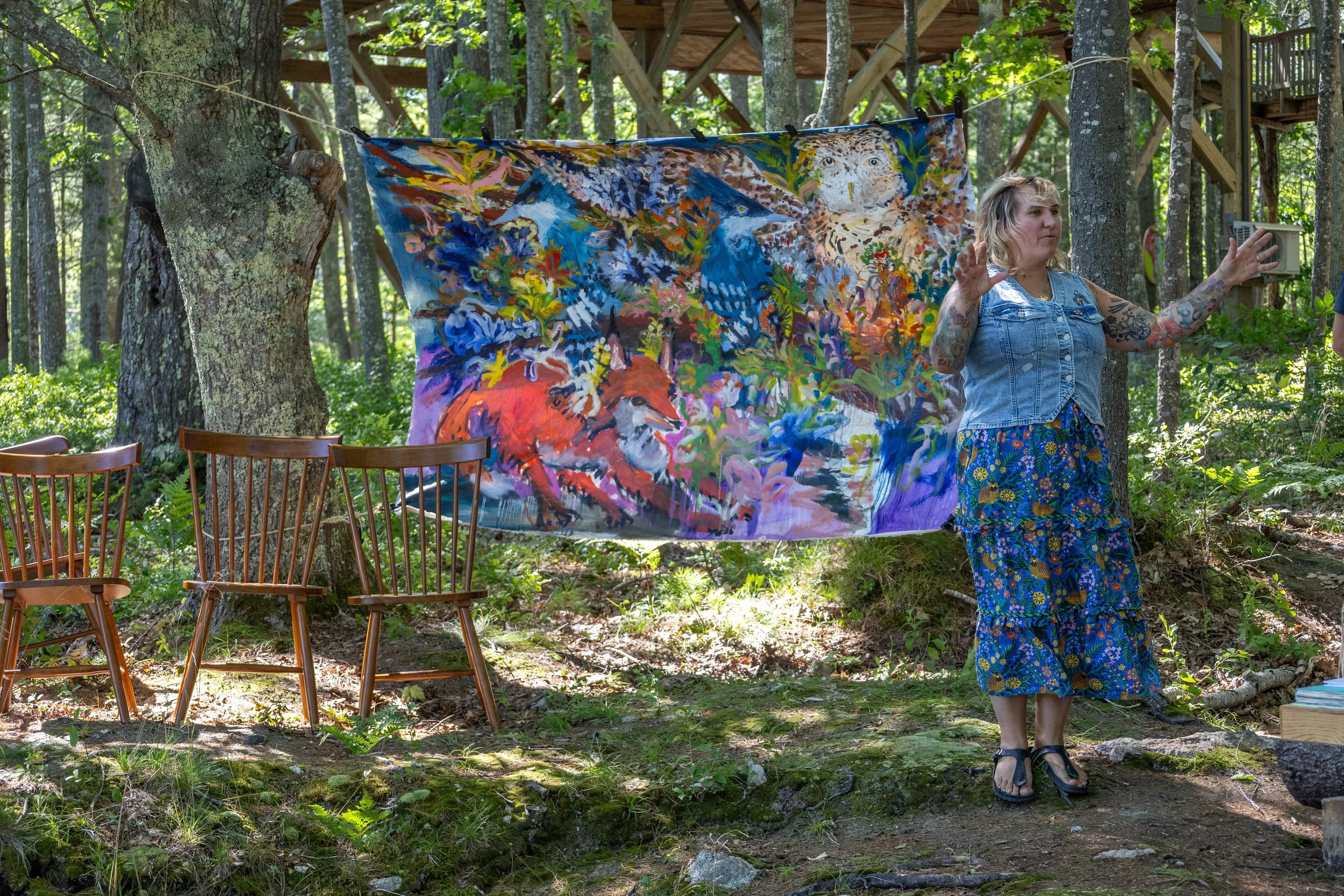
Ethridge presenting at Seguinland Institute
Alicia Ines Ethridge (b. 1984, New Jersey) is a visual artist based on the coast of Maine. Ethridge holds an MSW in Expressive Arts from the University of Southern Maine and a BA in Anthropology and Art History from Montclair State University. She has also studied at the Maine College of Art. Her work has been exhibited in museums and galleries across New England.
Artist Statement
My painterly practice operates as a bridge between the physical geography of the earth and the visionary geography of the subconscious. Working across Contemporary Magic Realism, Neo-Symbolism, and Bio-Mystical Abstraction, I create large-scale oil paintings that interweave tactile botanical environments with mythic animal archetypes. Within these dream-drenched canvases, creatures—wolves, corvids, foxes, and ospreys—emerge from glowing, gestural passages of paint. They are not passive subjects of natural history; rather, they serve as living messengers, embodying transformation, resilience, and the deep, instinctual self.
At the heart of my methodology is a dual practice of outer gathering and inner exploration. Outwardly, my creative process begins with a practice of collectanea anchored by pilgrimages to sacred places. I return continually to landscapes that hold profound spiritual resonance: childhood memory sites like the mountain stream home of the Naga on Pantherkill Mountain in the Catskills, the tidal shores of Passamaquoddy Bay in Lubec, Maine, the rugged perimeter of Campobello Island, the shifting salt marshes of the Rachel Carson Refuge in Southern Maine, and the avian sanctuary of Plum Island, Massachusetts. Walking these coastal edges, mountain waters, and marshlands, I collect physical artifacts—botanical fragments, stones, feathers, and bone—bringing the tangible energy and ecology of these places directly into my studio space.
Inwardly, this physical gathering is paired with visionary inquiry. Through shamanic journeying, guided imagery, and altered states of quiet attunement, I travel deep into the unseen world. In these altered spaces, archetypes and animal spirit forms present themselves not as intellectual concepts, but as living presences.
The movement from vision to physical artifact occurs in stages: these inner encounters are first captured in fluid drawings, where line and form begin to synthesize the gathered natural relics with subconscious visions. From there, they are translated onto large-scale canvases using oil paint—a medium whose physical materiality, viscosity, and luminous transparency allow for endless layering, glazing, and gestural momentum.
Visually, the work balances the precise detail of flora and fauna with sweeping, atmospheric abstraction. Paint is applied with visceral intensity—sometimes thick and tactile, sometimes vaporous and dissolving—reflecting the threshold state where physical form meets spirit. Themes of cyclical metamorphosis, cosmic events, seasonal shifts, and species kinship run throughout the paintings.
Ultimately, my work is an act of re-enchantment. In a contemporary world increasingly severed from the natural realm, these canvases offer a sanctuary of reverence. They remind us that the earth is not a static backdrop, but a sentient, mythic web—and that by attending closely to its wild rhythms, we uncover the hidden architecture of our own inner lives.